When Hunger Feels Like Danger: Breathwork as a Tool for Binge Eating Awareness
When Hunger Feels Like Danger: Breathwork as a Tool for Binge Eating Awareness
Most people assume binge eating is about lack of discipline or willpower.
But for many, it’s not about food at all.
It’s about safety.
If you’ve ever found yourself eating an entire bag of chips before you even realized what was happening, or finishing a sleeve of cookies and only “coming back to awareness” once they were gone — you’re not alone, and you’re not broken. Your nervous system is doing something it learned to do a long time ago:
It’s protecting you.
For some, hunger feels threatening, and fullness feels like relief — even if the fullness leads to guilt afterward. This can create a cycle that feels impossible to break.
But it can be understood — and with practice, gently reshaped.
Hunger is not just physical. It’s emotional and nervous-system based. Hunger is one of our primal homeostatic sensations like thirst, tiredness, or the need to breathe. These sensations are meant to simply signal that something in the body needs attention.
But in real life, these sensations rarely feel neutral.
They become linked with emotion. Depending on our history, hunger might feel like panic. Fullness might feel like safety. Eating might become a way to numb, soothe, or distract.
This is where shame often enters the picture — not because hunger is wrong, but because of the meaning we attach to it.
The sensation itself is primal.
The emotion layered on top is learned.
Interoception: Feeling Our Internal World
We all have the ability to sense what’s happening inside our bodies — this is called interoception.
But if hunger has been linked to emotional discomfort, we may react to the emotion, not the sensation. The body signals hunger → the mind interprets danger → the nervous system reacts.
This process can feel overwhelming and immediate. The binge is often an attempt to quiet the alarm.
Why Breathwork Helps
Breathwork doesn’t erase hunger.
It helps regulate the nervous system response to hunger.
When we slow and deepen the breath:
Arousal decreases
The emotional urgency quiets
The brain gets a moment to reassess what the sensation actually means
In other words, breathwork creates space between sensation and reaction.
We move from hunger → panic → binge to hunger → pause → awareness → choice
That pause is powerful.
That pause is rewiring.
A Simple Practice to Try Before Eating
This is not about restriction.
This is about awareness.
Try this once a day:
Before you eat, pause for 90 seconds.
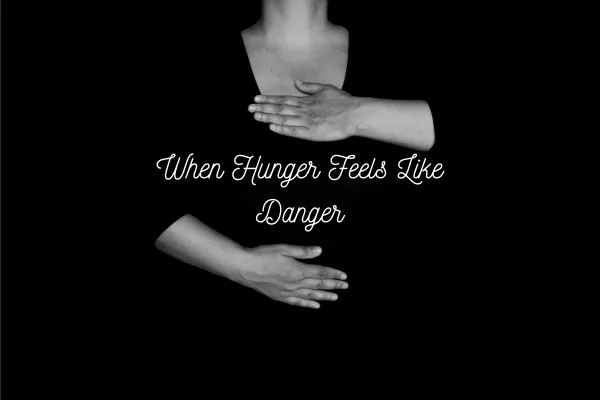
Place one hand on the chest and one on the belly.
Breathe gently through the nose:
Inhale for 3 seconds
Exhale for 6 seconds
Repeat for 6–10 rounds.
Ask yourself:
What sensation is here?
What emotion is here?
What do I truly need right now?
There are no wrong answers.
The goal is not to change the behavior — just to witness it.
The win is the pause.
Do We Need to Understand Where the Emotions Came From?
Not always.
Understanding can be helpful, yes. But healing often begins not with why — but with presence.
Learning to sit with the sensation without immediately reacting to it begins to untangle the pattern, slowly and gently.
In time, the body learns:
Hunger is safe.
Fullness is not the only form of comfort.
Food is nourishment, not protection.
For those who hold spiritual belief, understand that our bodies were created with wisdom.
The signals they send are not punishments — they are invitations back to care, connection, and presence.
And as we practice awareness, we may find that the space created is not empty — it is supported.
This work is not about perfection.
It is about beginning to listen — kindly.
Hunger is not an emergency.
Fullness is not “safety”.
Food is not the enemy.
Your body is asking for care.
Breath is one way we learn to respond.
If you’ve struggled with binge eating, the healing doesn’t start with the food — it starts with creating space to feel without fear.
And that space can begin with the breath.